
Air traffic controllers operate in a constantly changing environment where aircraft movements, weather conditions, operational priorities, and unexpected developments must be managed simultaneously. Their work requires more than rapid reactions or the ability to handle multiple tasks. Controllers must understand the current traffic situation, anticipate how it may evolve, identify potential conflicts, and make timely decisions while maintaining safety and operational efficiency.
What does it actually mean to think like an air traffic controller? The answer lies in a combination of cognitive abilities, including situation awareness, mental modelling, anticipation, attention management, planning, and decision-making under uncertainty. Drawing on established aviation human factors research, this article explores these abilities and introduces Think Like an Air Traffic Controller (TLATC) as a proposed educational and conceptual framework.
TLATC is not an established scientific theory, a validated assessment instrument, or an official air traffic control methodology. Rather, it offers a structured interpretation of existing research to explain how controllers understand complex situations, anticipate developments, and adapt their decisions as operational conditions change.
What Does It Mean to Think Like an Air Traffic Controller?
Consider a controller managing several aircraft approaching an airport. One aircraft is established on final approach, another is entering the terminal area, and a departing aircraft is preparing for takeoff. Each movement has its own operational requirements, but the controller must understand how these movements relate to one another. The central challenge is not simply knowing where aircraft are, but anticipating where they may be and how their movements could affect the overall traffic situation.
The National Research Council (1997), in Flight to the Future: Human Factors in Air Traffic Control, describes how controllers maintain an operational picture, develop plans, monitor traffic, and adapt their actions to changing circumstances. Similarly, D’Arcy and Della Rocco (2001), in an FAA study based on 100 controller interviews, identified safety, situation awareness, planning, backup strategies, and teamwork as important characteristics of controller decision-making.
These findings suggest that thinking like an air traffic controller involves a coordinated set of cognitive processes rather than a single skill. Effective performance depends on understanding the wider operational environment, recognizing developing situations, and selecting appropriate actions within established procedures and safety requirements.
The Cognitive Science Behind Air Traffic Control
Situation Awareness and Mental Models
Situation awareness is a central concept in aviation human factors. Endsley’s (1995) influential model describes three levels: perception of relevant environmental elements, comprehension of their meaning, and projection of their future status. In air traffic control, these processes involve identifying aircraft positions, altitudes, speeds, and operational constraints; understanding the relationships among them; and anticipating how the traffic situation may develop.
Controllers also construct what is commonly described as a mental picture of traffic. This internal representation incorporates relevant aircraft movements, expected trajectories, operational restrictions, and potential interactions. Malakis and Kontogiannis (2013) examined how controllers construct and revise these mental pictures through sensemaking, problem recognition, and replanning. Their research highlights that effective situation awareness is not about remembering every available detail but about recognizing the information and relationships most relevant to operational decisions.
Planning, Expertise, and Cognitive Limitations
Experienced controllers may recognize familiar traffic patterns and develop appropriate strategies without consciously comparing every possible alternative. This is consistent with research on naturalistic decision-making, which examines professional decisions made under uncertainty, time pressure, and changing conditions (Klein, 2008). Experience can support pattern recognition, anticipation, and flexible planning, but it does not eliminate human limitations involving attention, working memory, fatigue, or workload. Effective expertise therefore includes recognizing when expectations are no longer valid and adjusting decisions accordingly.
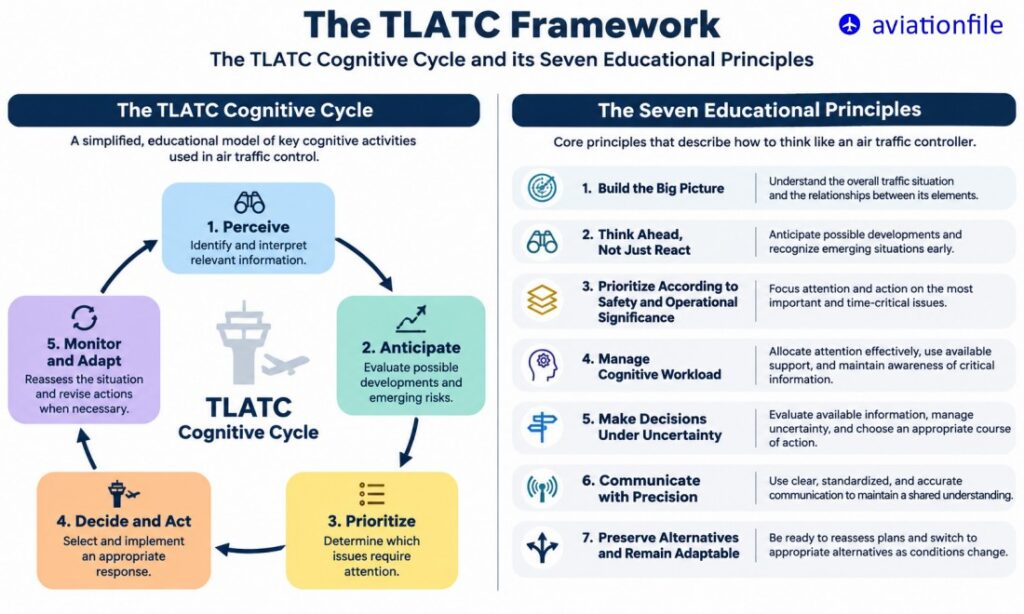
Seven Principles of Thinking Like an Air Traffic Controller
The following seven principles provide the educational foundation of the proposed TLATC framework. They represent a synthesis of existing research rather than independently validated dimensions of controller cognition.
1. Build the Big Picture
Controllers must understand the overall traffic situation rather than treating aircraft as isolated objects. This involves recognizing relevant movements, operational constraints, and relationships between aircraft. While tower, approach, and area control involve different information sources, geographical scales, and planning horizons, all require an integrated understanding of the operational environment. The essential question is: How are the different elements of the traffic situation connected?
2. Think Ahead, Not Just React
Anticipation enables controllers to recognize developing situations before they require urgent intervention. Aircraft may currently be adequately separated while their projected trajectories indicate a potential future interaction. Controllers therefore consider expected movements, uncertainty, applicable separation requirements, and available options. Anticipation does not imply perfect prediction; it involves developing informed expectations and continuously updating them as new information becomes available.
3. Prioritize According to Safety and Operational Significance
Air traffic control involves competing demands, including aircraft requests, coordination requirements, changing weather, and unexpected operational events. Controllers must determine which issues require immediate attention and which can appropriately be delayed or managed through coordination. Such prioritization takes place within established rules and procedures rather than through unrestricted personal judgment. The central objective is to direct attention and action toward the most significant operational requirements.
4. Manage Cognitive Workload
Human attention and working memory are limited, making workload management essential in complex traffic environments. Effective controllers allocate attention selectively, use established procedures and technological support, and coordinate with colleagues when necessary. Managing workload is not simply about performing more tasks simultaneously; it involves recognizing cognitive demands, maintaining awareness of critical information, and reducing the likelihood that important developments will be overlooked.
5. Make Decisions Under Uncertainty
Controllers frequently operate with incomplete or changing information. Aircraft performance, weather developments, technical problems, and operational restrictions may differ from expectations. Effective decision-making requires distinguishing established facts from assumptions, considering available evidence, and selecting actions consistent with safety requirements and applicable procedures. Uncertainty must be recognized and managed rather than ignored.
6. Communicate with Precision
Air traffic control depends on accurate communication among controllers, pilots, and other operational participants. Standardized phraseology, readback and hearback practices, and coordination procedures support the correct exchange and interpretation of information. Communication is not merely the final step of decision-making; it is an essential part of maintaining a shared understanding of the operational situation and implementing decisions safely.
7. Preserve Alternatives and Remain Adaptable
Operational plans may become unsuitable when aircraft movements, weather conditions, runway availability, or other circumstances change. Controllers must remain capable of reassessing their strategies and identifying appropriate alternatives. D’Arcy and Della Rocco (2001) found that more experienced controllers were more likely to report developing backup strategies. This supports the importance of flexibility, although it does not imply that controllers maintain a complete alternative plan for every possible situation.
The TLATC Framework: A Proposed Cognitive Cycle
Based on these principles, this article proposes the Think Like an Air Traffic Controller (TLATC) Cognitive Cycle, an educational model consisting of five interconnected activities:
Perceive → Anticipate → Prioritize → Decide and Act → Monitor and Adapt
| Stage | Cognitive activity | Guiding question |
|---|---|---|
| Perceive | Identify and interpret relevant information about the operational environment. | What is happening? |
| Anticipate | Evaluate possible developments, interactions, and emerging risks. | What could happen next? |
| Prioritize | Determine which issues require attention according to operational significance and applicable requirements. | What matters most now? |
| Decide and Act | Select and implement an appropriate response within established procedures. | What action is justified? |
| Monitor and Adapt | Reassess the situation and revise expectations or actions when necessary. | Has the situation changed? |
Although presented sequentially for educational clarity, these activities are interconnected and may occur simultaneously or repeatedly. A new observation can change an anticipated trajectory, while revised priorities may require a different plan. The framework is therefore a simplified representation of dynamic cognitive processes rather than a rigid sequence of operational actions.
The TLATC Cognitive Cycle does not replace established situation awareness theories, naturalistic decision-making models, or official ATC procedures. Its proposed contribution is to organize existing cognitive concepts into an accessible structure that may support education, discussion, and future research. Its effectiveness as a teaching framework has not yet been empirically evaluated.
Practical Example: Thinking Ahead of the Aircraft
Consider an airport where an arriving aircraft is approaching the runway, another aircraft is waiting for departure, and a third is taxiing toward a runway holding position. A reactive description focuses on each event individually: the arrival continues its approach, the departure requests clearance, and the taxiing aircraft reports its position.
An anticipatory assessment considers how these movements may interact. Will the runway be available when needed? Could the intended departure affect the arriving aircraft? What happens if the departure is delayed or the arrival initiates a go-around? The controller must evaluate these possibilities while complying with applicable separation standards, runway safety requirements, and local procedures.
This simplified example does not prescribe a particular clearance or traffic sequence. It illustrates how controller-oriented thinking involves evaluating potential developments rather than responding exclusively to events that have already occurred.
Can People Learn to Think Like an Air Traffic Controller?
Several cognitive principles associated with air traffic control, including situation awareness, anticipation, prioritization, and adaptive planning, can be introduced through education and scenario-based exercises. Students might examine a simplified traffic situation, identify relevant information, predict possible developments, and discuss operational priorities. Such activities can help explain the cognitive demands of air traffic control and encourage structured thinking.
However, understanding these principles is not equivalent to acquiring professional controller competence. Air traffic controllers develop their expertise through specialized theoretical instruction, simulation, supervised operational training, assessment, and practical experience. The TLATC framework may support conceptual learning, but claims that it improves operational performance would require empirical evidence.
Recommended: Situational Awareness in Aviation
Beyond Aviation: Applications in Other Complex Environments
Air traffic control shares certain cognitive challenges with emergency response, healthcare, transportation management, logistics, and industrial operations. These environments may require professionals to monitor changing conditions, recognize interdependencies, anticipate disruptions, prioritize competing demands, and adapt decisions under uncertainty.
For example, emergency departments must anticipate patient demand and resource limitations, while logistics managers may need to identify developing disruptions before they affect interconnected operations. The TLATC framework offers a possible educational perspective for discussing these challenges. Nevertheless, professional expertise is domain-specific, and the transfer of cognitive skills between industries cannot be assumed without supporting research.
Thinking Like a Controller in the Age of Artificial Intelligence
Digital technologies, automation, and artificial intelligence are changing how information can be processed and presented in air traffic management. Decision-support systems may assist controllers with identifying patterns, anticipating traffic developments, and evaluating operational alternatives. However, their effectiveness depends on reliability, system design, transparency, appropriate human oversight, and integration into operational procedures.
EUROCONTROL’s Solutions for Human-Automation Partnerships in European ATM (SHAPE) framework addresses human-automation issues involving trust, situation awareness, and teamwork. From a TLATC perspective, the central question is not whether automated systems can process information faster than humans, but how they can support effective understanding, anticipation, and decision-making within the wider air traffic management system.
Scientific Scope and Limitations of the TLATC Framework
The TLATC framework is a proposed conceptual synthesis grounded in established research on situation awareness, mental models, cognitive workload, planning, and decision-making. It does not introduce previously unknown cognitive processes, establish that all controllers think identically, or claim that a universal decision-making sequence applies to every operational environment.
Its seven principles and five-stage cognitive cycle are intended as educational constructs rather than validated psychological dimensions or operational standards. Future research could examine their conceptual distinctiveness, educational usefulness, and potential effects on learning outcomes. Claims about improvements in controller performance or aviation safety would require appropriately designed empirical studies.
Conclusion: Think Ahead, Not Just Fast
Thinking like an air traffic controller involves more than rapid decision-making or managing multiple tasks. It requires understanding a dynamic environment, recognizing relationships, anticipating possible developments, evaluating priorities, communicating precisely, and adapting when circumstances change. These cognitive abilities operate within a professional system of procedures, training, technology, teamwork, and safety responsibilities.
The proposed TLATC framework brings these ideas together through one central principle:
A controller must understand not only where aircraft are, but also how the traffic situation may develop—and what that development could mean for safety.
The broader lesson is that effective decision-making in complex environments depends not merely on responding to the present, but on anticipating the future while remaining prepared to adapt.
References
- National Research Council. (1997). Flight to the Future: Human Factors in Air Traffic Control. National Academies Press. https://doi.org/10.17226/5493
- D’Arcy, J.-F., & Della Rocco, P. S. (2001). Air Traffic Control Specialist Decision Making and Strategic Planning: A Field Survey. FAA Report DOT/FAA/CT-TN01/05. https://hf.tc.faa.gov/publications/2001-air-traffic-control-specialist-decision-making/
- Endsley, M. R. (1995). Toward a theory of situation awareness in dynamic systems. Human Factors, 37(1), 32–64. https://doi.org/10.1518/001872095779049543
- Malakis, S., & Kontogiannis, T. (2013). A sensemaking perspective on framing the mental picture of air traffic controllers. Applied Ergonomics, 44(2), 327–339. https://doi.org/10.1016/j.apergo.2012.09.003
- Gronlund, S. D., Dougherty, M. R. P., Durso, F. T., Canning, J. M., & Mills, S. H. (2001). Planning in Air Traffic Control. FAA Report DOT/FAA/AM-01/16. https://www.faa.gov/data_research/research/med_humanfacs/oamtechreports/2000s/2001/0116
- Klein, G. (2008). Naturalistic decision making. Human Factors, 50(3), 456–460. https://doi.org/10.1518/001872008X288385
- Lipshitz, R., Klein, G., Orasanu, J., & Salas, E. (2001). Taking stock of naturalistic decision making. Journal of Behavioral Decision Making, 14(5), 331–352. https://doi.org/10.1002/bdm.381
- EUROCONTROL. Solutions for Human-Automation Partnerships in European ATM (SHAPE). https://www.eurocontrol.int/product/solutions-human-automation-partnerships-european-atm
Editorial note: The TLATC Cognitive Cycle and its seven educational principles are proposed in this AviationFile article as a conceptual synthesis of existing research. The framework has not been empirically validated and should not be interpreted as an official operational methodology or a substitute for applicable ATC regulations and training.
The post Think Like an Air Traffic Controller: The Science of Anticipation, Situation Awareness, and Decision-Making appeared first on aviationfile-Gateway to Aviation World.
 English